At iExec, after months of market research, sector analysis, and 100+ qualitative interviews, one conclusion kept surfacing above everything else: Real World Assets are the next growth engine for crypto, and confidentiality is the structural missing layer blocking them from scaling on-chain.
Two years ago, “institutions are coming to DeFi” was still a slogan. Today, it’s a market.
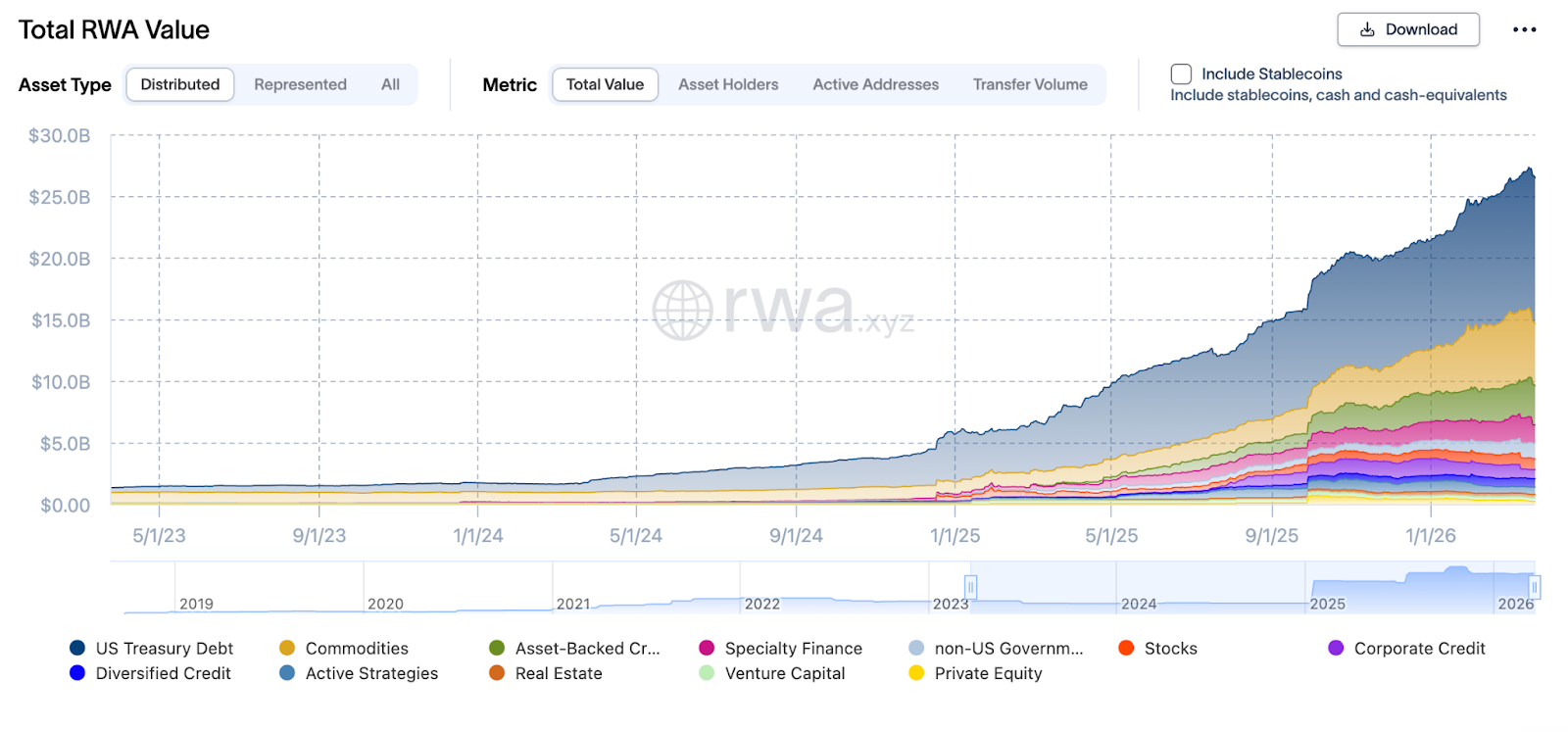
Source - rwa.xyz - March 2026
The names moving capital aren’t startups making bets. BlackRock’s BUIDL holds $2B. Franklin Templeton’s BENJI crossed $1B. These are production products, not pilots.

Source - rwa.xyz - March 2026
The reason institutions are moving is clear: blockchain offers something traditional financial infrastructure cannot.
These are structural advantages that change the economics of how assets are issued, distributed, and managed. Institutions are not here for the beauty of the technology, they are here to capture new market share.
To make this possible, tokenization is the gateway, and the market figures confirm it.
Tokenization is the mechanism by which a real-world asset, whether a treasury, a private credit facility, or a real estate fund, becomes a digital token that can move on public infrastructure, be held in self-custodied wallets, and interact with DeFi protocols.
Tokenization changes who can access an asset, how it settles, and what it can do once it is on-chain. This is why every major financial institution is watching, and why the ones who have committed are scaling.
And yet the addressable market is estimated at $100 trillion (iExec GTM analysis from multiple sources, including defillama, dune x RWA report and Boston Consulting Group report). Today, $27B has made it on-chain. That’s 0.027%.
The missing layer is confidentiality. Here is why.
When a fund manager tokenizes a position on a public blockchain, every investor's balance, every subscription amount, and every redemption flow becomes visible to anyone with a block explorer. In traditional finance, none of this is public. Keeping it private is not optional; it is a legal obligation in most jurisdictions.
In practice, this creates problems for any institution that tries to tokenize. To understand this better, we ran 100+ qualitative interviews across Europe, APAC, and LATAM with fund operators, compliance experts, and builders. Here are the key takeaways.
We identified that full transparency is operationally incompatible with institutional mandates, not because institutions want to hide from oversight, but because their legal obligations require them to protect investor data, and their competitive position depends on protecting strategy.
We identified that compliance is the unlock, not the barrier. Institutions gain confidence to adopt confidential infrastructure when it comes with a demonstrated compliance architecture. The product that shows regulators exactly what they need to see is the product that gets integrated.
We identified that the fear of being misinterpreted as non-compliant limits adoption more than any technical friction. Institutions don’t avoid privacy tools because the cryptography is wrong. They avoid them because the tools signal the wrong intent: anonymity rather than selective disclosure, opacity rather than controlled visibility.
Institutions don’t want opacity. They want control over who sees what. The ability to be confidential to the market and auditable to regulators at the same time. Not hidden from everyone. Not visible to everyone. Selective disclosure is the winning privacy model.
Months of research. Hundreds of interviews. One conclusion: the missing layer is confidentiality, and it is the only thing standing between today's $27B and the $100T addressable market.
As one institutional DeFi infrastructure builder put it: "If institutions are moving billions on-chain, they don't want to announce it to everyone. Confidentiality at scale equals competitive survival, not secrecy."
Our Confidential Token is iExec's answer to that gap. Built for institutions and RWA players who need the benefits of blockchain without the exposure they're legally and competitively obligated to avoid.
The solution is to be released next week at ETHCC Cannes.
Stay tuned.